


ESP7
KAMA
| Suggested payload8T: | |
|---|---|
| Seat line: | |
| Max. Speed(Km/h): | |
| Range(CLTC): | |
| PACK(kW·h) : | |
| Warranty: | |
| Quantity: | |
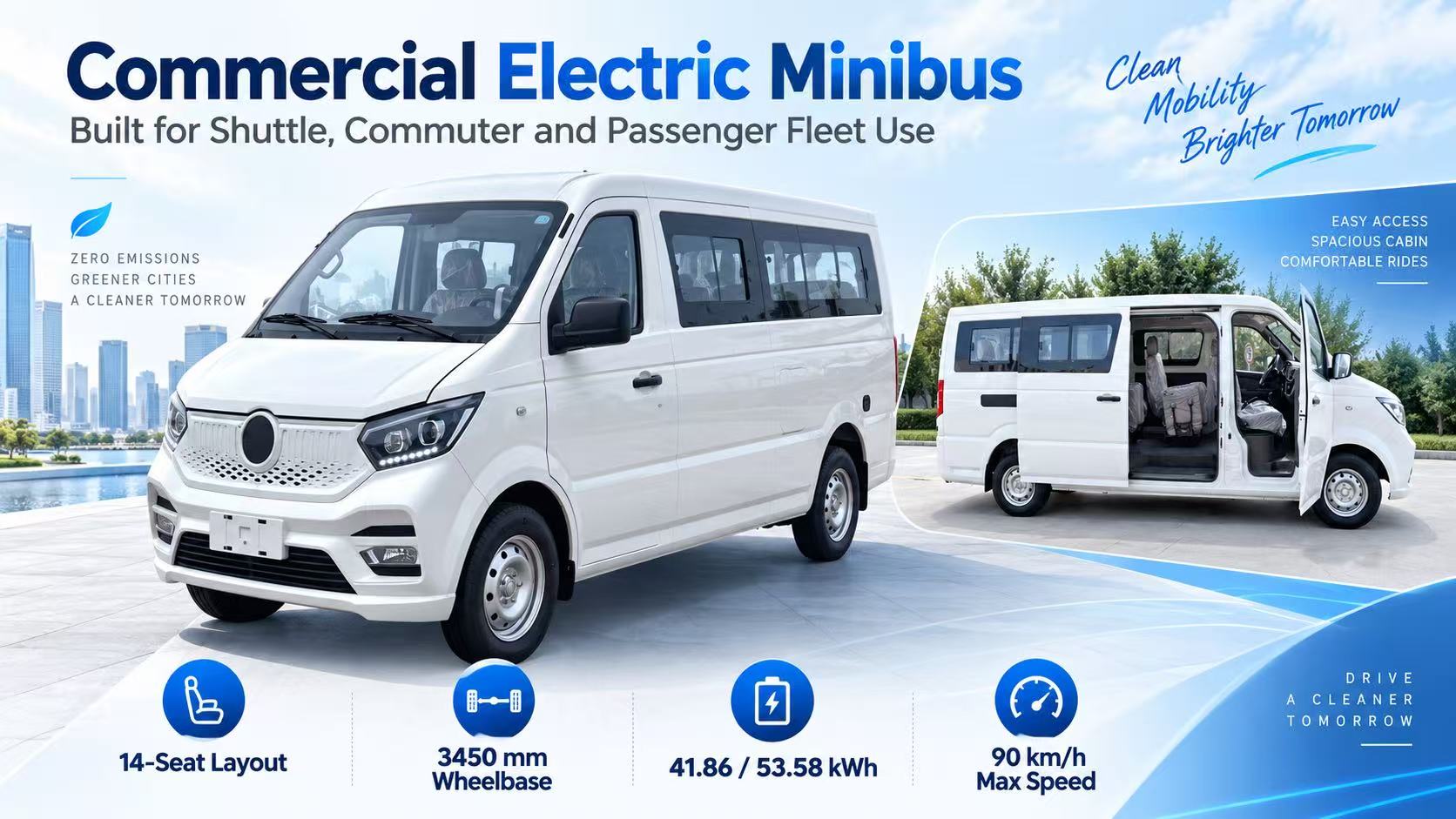
Passenger transport fleets need more than maximum driving range.
For staff transportation, hotel shuttle services, tourism and fixed-route passenger operations, vehicle capacity, daily mileage, charging time, cabin comfort and operating cost all influence the final purchasing decision.
This 14-seater electric minibus is designed for commercial passenger transportation with a practical balance between passenger capacity, vehicle size and electric driving range.
The ESP7 uses a 3450 mm wheelbase, provides seating for up to 14 passengers, and can be equipped with CATL lithium iron phosphate battery configurations of 41.86 kWh or 53.58 kWh, with reference WLTP ranges of approximately 220 km or 280 km depending on configuration. 2026 KAMA AUTO CATALOGUE - EV
Typical applications include:
Employee and staff transportation
Hotel shuttle service
Airport transfer
Tourism
Corporate commuter service
Industrial park transportation
Commercial passenger fleets
Fixed-route shuttle operations
For fleet buyers, the vehicle should be selected according to actual route length, passenger load and available charging time rather than battery capacity alone.
The ESP7 uses a passenger-focused interior layout with:
providing a total capacity of approximately:
This passenger capacity places the vehicle between smaller passenger vans and larger electric minibuses.
A 14 seat electric van can be particularly useful for operators that need more capacity than a conventional passenger van but do not require a full-size bus.
Potential operators include:
Factories, offices and industrial parks can use fixed-route electric shuttles for daily employee transportation.
Hotels and resorts can operate predictable routes between hotels, airports, transport terminals and tourist destinations.
Businesses can use electric passenger vans for employee pickup and scheduled transportation.
A compact electric minibus can support small-group city tours and short-distance tourism routes.
Operators with fixed daily schedules can evaluate electrification where charging can be planned around operating hours.
The vehicle uses a:
with overall dimensions of approximately:
The 1715 mm-wide platform provides a relatively compact exterior footprint compared with a full-size electric bus while offering multiple passenger rows. 2026 KAMA AUTO CATALOGUE - EV
For commercial passenger operators, this can be useful in:
Dense urban streets
Hotel entrances
Airports
Industrial campuses
City shuttle routes
Tourism areas
The objective is to provide useful passenger capacity without adding unnecessary vehicle size.
Two battery configurations are listed for the electric passenger van.
CATL 41.86 kWh
CATL 53.58 kWh
Both configurations use:
battery chemistry. 2026 KAMA AUTO CATALOGUE - EV
For commercial passenger fleets, battery selection should be based on actual daily operation.
Fleet operators should consider:
Daily route length
Number of trips
Passenger load
Air-conditioning use
Available charging time
Route gradient
Ambient temperature
Choosing the largest battery is not always necessary.
A vehicle operating relatively short staff shuttle routes may benefit from a smaller battery configuration, while longer passenger routes may justify greater battery capacity.
Depending on battery configuration, the vehicle is listed with approximately:
or:
reference driving range. 2026 KAMA AUTO CATALOGUE - EV
Actual commercial operating range can differ from the reference figure.
Factors include:
Passenger load
Air-conditioning
Vehicle speed
Traffic
Ambient temperature
Road gradient
Driving style
Passenger fleets should therefore calculate range according to the real duty cycle.
For example:
A hotel shuttle travelling 80–120 km per day has a very different battery requirement from a vehicle completing several regional passenger routes.
The most useful question is:
Can the vehicle complete the longest normal working day and return to a reliable charging point with sufficient reserve?
The electric powertrain uses a Wuhan LinControl motor system.
35 kW
70 kW
90 km/h
2026 KAMA AUTO CATALOGUE - EV
For passenger shuttle applications, electric drive can provide several practical characteristics:
Smooth acceleration
Lower drivetrain noise
No engine idling
Suitable stop-and-go operation
Predictable energy consumption on fixed routes
These characteristics can be particularly useful for hotel, staff and city shuttle operations.
Employee transport is one of the clearest use cases for a commercial electric minibus.
Many factories, offices and industrial parks operate predictable routes:
Employee Pickup
↓
Workplace
↓
Scheduled Return
This creates a controlled operating pattern.
Fleet managers usually know:
Route distance
Departure time
Passenger quantity
Parking location
Charging time
This makes staff transportation one of the easier passenger applications to evaluate for electrification.
Hotels and hospitality businesses often operate frequent but predictable passenger routes.
Examples include:
Hotel to airport
Hotel to railway station
Hotel to tourist attraction
Resort internal transportation
An electric shuttle van can be considered where vehicles return regularly to a fixed parking location.
For these customers, important buying criteria include:
Passenger capacity
Air conditioning
Interior access
Daily mileage
Charging
rather than maximum theoretical range alone.
Tourism operators may also evaluate a compact electric passenger van for:
City tours
Resort transportation
Scenic-area shuttles
Small-group transfers
Short-distance tourism routes
Compared with a larger bus, a 14-seat platform can provide greater route flexibility for small passenger groups.
The feasibility of electric operation depends heavily on the itinerary.
Routes with predictable daily distance and overnight charging are generally easier to electrify than irregular long-distance tourism services.
Passenger vehicle range should not be evaluated in the same way as cargo vehicle range.
For a passenger minibus, air-conditioning can become a significant auxiliary energy load.
This is particularly important for hot-climate markets.
Fleet buyers should therefore consider:
Outside temperature
Number of passengers
Daily operating hours
Frequency of door opening
Air-conditioning settings
when estimating real operating range.
For Africa, South America, the Middle East and Southeast Asia, this can be more important than small differences in brochure range.
Fleet buyers frequently focus on battery size first.
A more practical decision sequence is:
How many passengers need to travel per trip?
How far does the vehicle actually travel?
How many hours can it charge?
How heavily will air conditioning be used?
Choose a battery configuration that supports the duty cycle with reasonable reserve.
This method can help avoid purchasing unnecessary battery capacity.
Not every passenger operator needs the largest available vehicle.
A 14-seat electric passenger platform can be more suitable when:
Passenger groups are moderate
Urban maneuverability matters
Routes are relatively short
Vehicles make frequent stops
Parking space is limited
A larger passenger vehicle may be more appropriate when:
Passenger volume is consistently higher
Fewer trips are preferred
Routes can support a larger vehicle
Fleet operators should compare passenger occupancy rather than simply purchasing the highest-capacity vehicle.
This section should become an important internal-link module.
| Vehicle Type | Best Fit |
|---|---|
| 14-seat electric minibus | Staff, hotel, airport and corporate shuttle |
| Larger electric passenger van | Higher passenger-volume routes |
If your fleet requires greater passenger capacity, compare our [larger electric passenger van] configuration.
这里直接链接现有 ESP8 页面。
锚文本不要使用 KAMA ESP8。
| Specification | Value |
|---|---|
| Power Type | Battery Electric |
| Model | ESP7 |
| Passenger Capacity | Approx. 14 Seats |
| Suggested Payload | 1T |
| Wheelbase | 3450 mm |
| Overall Dimensions | 5265 × 1715 × 2065 mm |
| Curb Weight | 1750 kg |
| GVW | 3150 kg |
| Maximum Speed | 90 km/h |
| Tire | 185R14LT |
| Wheels | 4 + 1 |
| Brake System | Hydraulic Brake |
| Battery Brand | CATL |
| Battery Type | Lithium Iron Phosphate |
| Battery Capacity | 41.86 / 53.58 kWh |
| Reference Range | 220 / 280 km WLTP |
| Motor | Wuhan LinControl |
| Rated / Peak Power | 35 / 70 kW |
The specifications are based on the 2026 electric commercial vehicle catalogue and should be confirmed against the final order configuration. 2026 KAMA AUTO CATALOGUE - EV
The catalogue lists standard equipment across the ES/ESP platform including:
ABS
Power steering
MP5 multimedia
Air conditioning
Power windows
Central locking
2026 KAMA AUTO CATALOGUE - EV
For passenger fleets, actual equipment should be confirmed according to the destination market and final vehicle specification.
Fleet electrification should include the charger from the beginning.
A passenger operator should calculate:
Number of Vehicles
×
Daily Energy Consumption
×
Available Parking Time
before selecting charging infrastructure.
A fleet running morning and evening staff routes may have a long charging window during the day.
A hotel shuttle operating continuously may require a different charging strategy.
This is why passenger fleet charging should be designed around the operating schedule.
Daily employee transportation between fixed pickup points and workplaces.
Scheduled passenger transfers with known route distances.
Frequent short-distance passenger transportation.
Small-group transport and sightseeing.
Internal or local workforce movement.
Scheduled employee and visitor transportation.
Suitable where daily mileage and charging can be planned.
Passenger transportation is highly sensitive to vehicle downtime.
If one shuttle vehicle stops operating, it may immediately affect:
Passenger schedules
Staff transportation
Hotel operations
Fleet capacity
For this reason, buyers should evaluate:
Common spare parts
Diagnostic tools
Service manuals
Technical support
Local workshop capability
before scaling fleet size.
Passenger EV procurement should therefore include after-sales preparation from the first order.
The ESP7 passenger layout is approximately 14 seats, based on the listed 2+3+3+3+3 seating configuration. 2026 KAMA AUTO CATALOGUE - EV
The catalogue lists CATL lithium iron phosphate battery options of approximately 41.86 kWh and 53.58 kWh. 2026 KAMA AUTO CATALOGUE - EV
Reference WLTP ranges are approximately 220 km and 280 km, depending on battery configuration. Actual range depends on passenger load, temperature, speed, air-conditioning and route conditions. 2026 KAMA AUTO CATALOGUE - EV
The listed maximum speed is approximately 90 km/h. 2026 KAMA AUTO CATALOGUE - EV
Yes. A predictable staff-shuttle route can be a suitable use case because daily mileage, passenger quantity and charging time can be planned in advance.
It can be evaluated for hotel, airport and resort shuttle applications where route and charging conditions are suitable.
Yes. Buyers requiring higher passenger capacity can compare our [larger electric passenger van] options.
Configuration changes depend on the exact model, order quantity, technical feasibility and destination-market requirements and should be confirmed before quotation.
Distributors, fleet operators, hotels, factories, tourism companies and passenger transport businesses can evaluate this 14-seater electric minibus for commercial shuttle applications.
For an accurate vehicle recommendation, please provide:
Destination Country:
Required Quantity:
Daily Mileage:
Passenger Capacity:
Main Application:
Charging Standard:
Operating Temperature:
Destination Port:
Fleet or Distributor Purchase:
Final battery configuration, charging system, market compliance and commercial terms should be confirmed according to the specific project.


