Views: 0 Author: Site Editor Publish Time: 2026-07-20 Origin: Site
High fuel prices and stringent emissions targets are accelerating global demand for fleet electrification. This crucial shift positions China’s rapidly scaling manufacturing sector as a primary sourcing hub. Buyers worldwide eagerly look eastward for capable cargo platforms and logistics solutions. While the volume of exports is surging, global importers face a distinctly complex landscape. They must confidently navigate shifting trade policies and localized compliance hurdles.
Furthermore, securing reliable aftermarket support presents significant risks. Such risks can easily derail initial procurement plans if ignored. This guide provides fleet operators, distributors, and procurement managers with an evidence-based evaluation framework. It helps you assess viability and mitigate sourcing risks effectively. You will learn how to structure profitable acquisitions when sourcing these units in 2026. Ultimately, this knowledge allows you to optimize your supply chain securely and strategically.
Tariffs & Trade Policies are Defining Strategy: Regional tariff frameworks and trade regulations are forcing importers to weigh direct imports against SKD/CKD (Semi/Completely Knocked Down) local assembly partnerships.
Compliance Precedes Cost Savings: Securing regional homologation and battery safety certifications remain the strictest bottlenecks for successful procurement; certification standards differ widely across all markets.
Aftermarket Infrastructure is the Deciding Metric: Evaluating a supplier’s ability to provide localized parts networks, diagnostic software support, and long-term battery warranties is more critical than initial unit pricing.
Supplier Consolidation is Accelerating: Buyers must rigorously audit supplier financial health and production capacity, as aggressive market competition is filtering out undercapitalized OEMs.
The transition to zero-emission fleets requires careful financial modeling. High internal combustion engine (ICE) fuel costs push operators toward alternative energy. Regional subsidies further sweeten the transition. Chinese commercial platforms offer compelling initial price points. Vans, light trucks, and heavy-duty logistics vehicles dominate this manufacturing space. Fleet managers often calculate immediate operational savings. These savings stem primarily from cheaper electricity and fewer mechanical failures. The surging trend in electric commercial vehicle export shipments highlights this strong initial enthusiasm.
However, trade realities complicate the expenditure math. Multiple regions have rolled out targeted automotive trade regulatory adjustments, with differentiated import tax rules applied to imported commercial vehicles. These tariffs can instantly erase any upfront price advantages. You must model overall landed costs accurately. A cheap factory-gate price means little if customs duties double the final invoice. Strategic procurement teams now prioritize tariff mitigation over base vehicle pricing.
For some markets, importers may compare direct CBU import with SKD/CKD cooperation based on tariff policy and long-term market plan. Fluctuating cross-border trade rules introduce supply chain uncertainties. Deep local market integration becomes essential for long-term viability. Suppliers must root themselves in their target markets. They must establish physical footprints and strategic alliances. Otherwise, export longevity remains questionable at best. Buyers should view pure offshore sourcing with a highly skeptical lens.
Securing regulatory approval is the most rigid barrier to entry. Importers must verify target-market certifications meticulously. In Europe, Whole Vehicle Type Approval (WVTA) dictates legal road use. In the United States, Federal Motor Vehicle Safety Standards (FMVSS) serve the same purpose. You must ensure suppliers already hold these specific credentials. Never assume a domestic Chinese certification translates seamlessly abroad.
Modifying domestic-market models post-production introduces massive risks. Retrofitting lighting clusters or braking systems rarely meets factory quality standards. Such modifications often void underlying OEM warranties. Furthermore, makeshift compliance fixes frequently fail local safety inspections. This failure leaves expensive assets stranded at customs ports. You should demand factory-direct compliance for your specific region.
Common Mistake: Importers often accept "CE marks" on individual components as proof of whole-vehicle compliance. A certified battery does not guarantee a certified truck.
Battery chemistry dictates vehicle performance and lifespan. You must evaluate chemistries based on specific commercial duty cycles. Lithium Iron Phosphate (LFP) batteries dominate urban logistics. They offer superior thermal stability and longer lifecycle degradation curves. Nickel Manganese Cobalt (NMC) batteries provide higher energy density. NMC suits weight-sensitive, long-haul applications better. Match the battery type to your daily route requirements.
International battery warranties require strict legal scrutiny. Extended battery warranty terms can only be fully enforceable with established local service networks in your target territory. Verify the legal enforceability of these contracts in your jurisdiction. Additionally, end-of-life recycling obligations are becoming strict legal mandates. European regulations now demand comprehensive battery passports. You must establish clear recycling responsibilities before signing purchase agreements.
Modern fleets run on data. Fleet management system (FMS) API integration is non-negotiable. Your imported vehicles must communicate with your existing dispatch software seamlessly. Closed-loop, proprietary systems severely limit operational efficiency. Demand open architecture APIs from your overseas suppliers.
Data sovereignty compliance presents another major hurdle. Sending localized fleet data to foreign servers violates privacy laws in many regions. The General Data Protection Regulation (GDPR) in Europe imposes massive fines for such breaches. Cybersecurity concerns regarding foreign-sourced telematics hardware are growing rapidly. You should request independent cybersecurity audits of the vehicle’s onboard communication modules.
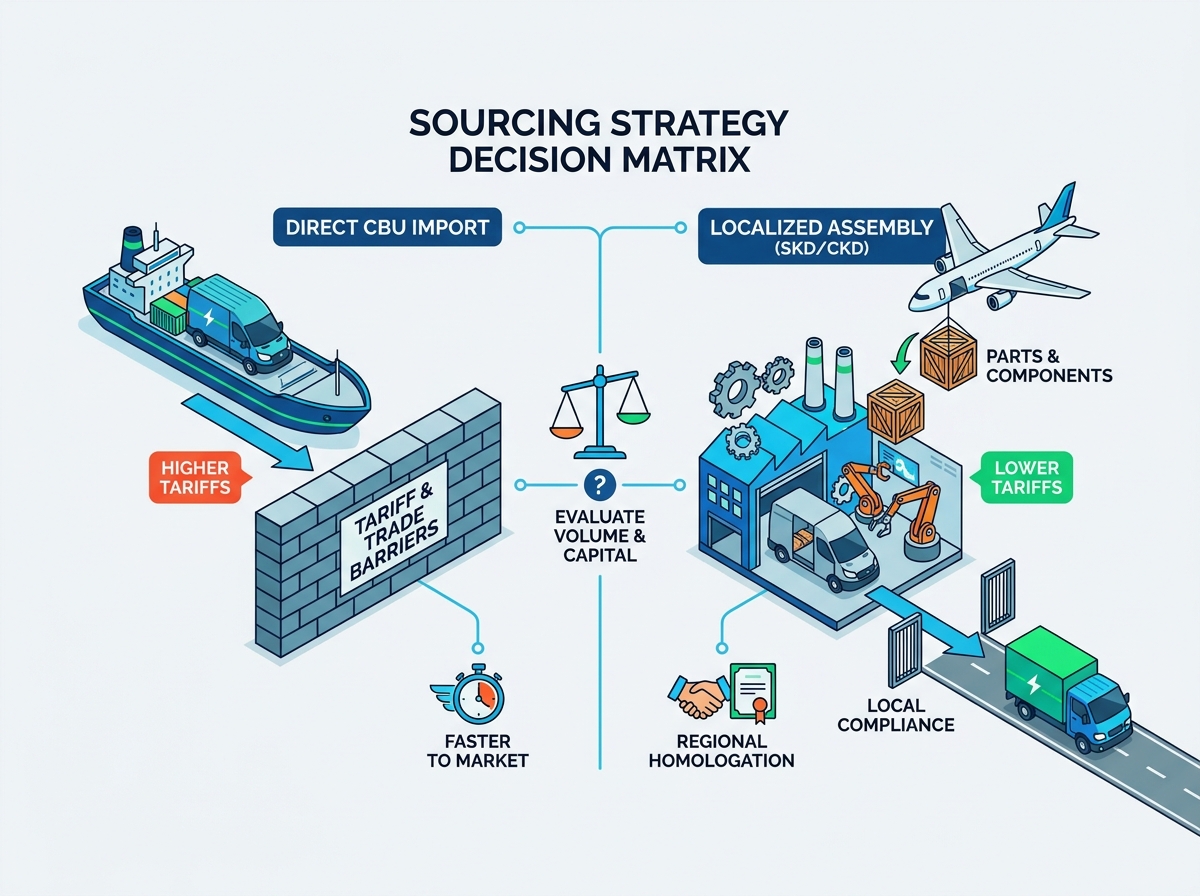
Importers face a critical fork in the road. They can import vehicles completely built, or assemble them locally. Direct CBU (Completely Built Up) imports offer distinct advantages. They provide rapid speed to market. They also require significantly lower initial capital expenditure. However, the drawbacks are becoming prohibitive. CBU models face maximum tariff exposure. Shipping fully assembled trucks is also incredibly inefficient regarding freight volume. Geopolitical exposure remains highest with this pure import model.
Leading importers and distributors are actively transitioning to local assembly. This shift involves SKD (Semi-Knocked Down) or CKD (Completely Knocked Down) manufacturing. Parts arrive in kits and local labor completes the assembly. This strategy effectively bypasses punitive whole-vehicle tariffs. It satisfies local content requirements and government incentive criteria. Furthermore, local assembly builds stronger political goodwill in the target market.
Choosing the right path requires careful capacity analysis. Importers must weigh their capital readiness against volume projections. A low-volume pilot might justify CBU imports initially. Mass fleet replacement almost always favors an SKD approach.
| Strategy | Capital Expenditure | Tariff Exposure | Time to Market | Ideal Volume |
|---|---|---|---|---|
| Direct Import (CBU) | Low | Very High | Fast (3-6 Months) | Low to Medium |
| Semi-Knocked Down (SKD) | Medium | Moderate | Medium (9-12 Months) | Medium to High |
| Completely Knocked Down (CKD) | High | Low | Slow (18-24 Months) | High (Mass Scale) |
The manufacturing landscape is undergoing aggressive consolidation. Buyers must rigorously audit supplier financial health. You need to differentiate between stated manufacturing capacity and actual export-ready throughput. Many factories boast massive production numbers. However, their ability to produce homologated, export-compliant units is often much lower. Cross-reference stated capacities with macro industry export data.
Supply chain traceability is no longer optional. International ESG standards demand absolute transparency in sourcing. Critical minerals and battery components face intense scrutiny. Regulations require proof that raw materials avoid conflict zones. Suppliers must provide auditable trails for their cobalt, lithium, and nickel. Failing to prove traceability can result in severe import bans at customs checkpoints.
Aftersales infrastructure separates reliable partners from risky vendors. Buyers must focus on evaluating the brand’s spare parts planning and technical support capability. A remote overseas warehouse cannot fully support local fleet uptime. You also need trained diagnostic technicians operating in your time zone. Ensure the supplier has established third-party service partnerships if they lack direct local subsidiaries. Never sign a procurement contract without securing this localized support network first.
Best Practice: Request a physical tour of the supplier's spare parts planning and technical support capability. If they cannot provide an address, reconsider the partnership immediately.
Structuring a successful vehicle acquisition requires a disciplined methodology. Use the following sequential framework to filter prospective suppliers.
Step 1: Define Operational Success Criteria. You must map out specific fleet requirements before engaging suppliers. Calculate maximum vehicle payload capabilities. Determine the required range under maximum load conditions. Verify charging infrastructure compatibility across your existing depots. Do not compromise these operational baselines for a cheaper unit price.
Step 2: Supplier Due Diligence. Create a rigorous evaluation checklist. Assess the OEM's financial stability through independent credit audits. Investigate their historical export volume to your specific continent. Examine their prior performance in similar geographic climates. A battery system designed for mild weather might fail in extreme winter conditions.
Step 3: The Pilot Program Protocol. Always structure a low-volume initial import batch. This pilot tests real-world financial viability. Measure actual energy consumption against marketing claims. Gauge driver acceptance regarding cabin ergonomics and software interfaces. Most importantly, test maintenance responsiveness. Intentionally trigger a service request to time the supplier's parts delivery speed.
Running this protocol prevents catastrophic, large-scale fleet failures. It provides empirical data to present to stakeholders. Only proceed to mass procurement after the pilot proves successful across all operational metrics.
Importing commercial EVs from China in 2026 offers significant operational advantages. The technology is mature, and the manufacturing scale is unmatched. However, this venture requires navigating a complex minefield. You will face rigorous compliance hurdles, unpredictable geopolitical shifts, and severe aftermarket support risks. Success belongs to buyers who prioritize long-term infrastructure over short-term price tags.
Procurement teams must take immediate, calculated action. Initiate deep financial audits of your shortlisted suppliers today. Consult local homologation experts to verify regulatory compliance before transferring any capital. Finally, model your overall landed costs meticulously. Include tariffs, localized aftermarket setup fees, and diagnostic tool licensing. A comprehensive strategy ensures your fleet electrification goals remain profitable and secure.
The suitable SKD or CKD model depends on destination country policy, local assembly capability, order quantity, vehicle type and factory confirmation.
Q: How do international tariffs affect the final cost of Chinese electric commercial vehicle exports?A: Tariffs drastically increase the final landed cost. A vehicle might have a low factory-gate price, but destination countries often apply differentiated import duties to protect local manufacturing. Buyers must calculate total landed costs, including freight, insurance, and region-specific variable tariffs, rather than relying solely on the initial factory quotation. Tariff gaps between CBU and KD models are most obvious in Africa, South America and Southeast Asia.
Q: What are the most common compliance failures when importing commercial EVs?A: The most frequent failures involve lighting arrays, braking systems, and battery safety certifications. Domestic Chinese models often adopt standards inconsistent with local regional regulations. Failing to secure target-market homologation before shipping leads to vehicles being detained or rejected at customs, and handling cycles differ by each territory. Western markets impose stricter standards than most emerging economies.
Q: How do Chinese OEMs handle international warranty claims on heavy-duty batteries?A: Most reputable OEMs now shift toward third-party local service partnerships. Instead of dispatching overseas technicians, they contract existing regional mechanics and supply them with authorized diagnostic tools. Buyers must verify the legality and coverage scope of these local service partnerships before purchasing, to secure accountable support for battery maintenance and replacement.
Q: Is it better to import whole vehicles or partner for local assembly in 2026?A: It depends on your business scale, target country industrial policies and long-term order forecast. Low-volume buyers generally prefer importing whole vehicles (CBU) due to lower upfront capital needs. However, as fleet volumes grow and regional import tax restrictions tighten, local assembly (SKD/CKD) becomes a viable long-term solution. Both models are mature mainstream export solutions for KAMA to serve global clients.
To recommend a suitable KAMA commercial vehicle solution, please share:
1. Destination country
2. Target EV model or vehicle type
3. Annual procurement quantity forecast
4. LHD or RHD requirement
5. Main operation & road condition scenario
6. Destination port
7. Battery type preference (LFP / NMC)
8. CBU, SKD or CKD cooperation preference
9. Company type: importer, distributor, fleet buyer or end user
KAMA can discuss EV specification matching and container & assembly packing plan discussion according to your confirmed cooperation needs and project conditions.


